A Stone está revolucionando o mundo das fintech focando em CX

Time to read:
StoneCo was founded with one goal in mind: to deliver fairer financial services to Brazilian retailers, breaking the duopoly of payment companies linked to large banks. The fintech company now offers point-of-sale machines, online payments, insurance, and other solutions to support hundreds of thousands of entrepreneurs as they expand their businesses.
Stone offers its customers greater value through innovative, high-quality services at more reasonable rates. This has influenced the company’s growth in recent years, enabling it to expand its portfolio to meet the demands of different lines of business within the payments market, while remaining 100% focused on its customers at every step. Its latest product is Ton, aimed at small businesses. Stone has also expanded the range of companies that constitute its brand. Its product portfolio has grown considerably, both to serve different markets and to offer varied payment options to its customers.
The company currently has 2.9 million active paying customers and BRL 10.2 billion in total revenue, with growth of 31% between the first quarter of 2022 and 2023.(Source Stone Investor Relations webpage – visited July 17, 2024)
This growth is linked to Stone'’s focus and priority on customer satisfaction. Its commitment to fast, personalized experiences has always been an important pillar of its business, which is why the company invested in Twilio to help it build a customer service solution that is 100% focused on the customer experience. The goal was to serve customers with quality and efficiency, using a flexible and customizable platform, while taking into account the specific needs of internal operations.
Partnership to grow and serve
Stone needed a customer engagement hub because it was struggling to meet its own customer experience aspirations.
Based on customer behavior, Stone knew it had to adapt its technology to deliver the best experience for its customers, including implementing digital service channels such as chat and WhatsApp. In 2019, Stone already wanted to migrate from telephone to written communication, so they decided that WhatsApp would be the best channel, especially since Brazil is currently the second largest user of the application in the world. There are 147 million people using WhatsApp daily, approximately 70% of the population.
One of the biggest challenges was the difficulty in providing Stone’s "enchanters"—as the company calls its customer service agents—with a consolidated view of all customer contacts in one place. Instead, interactions with sales and support via phone, email, WhatsApp, and highly structured messages (HSM) were displayed on different screens. This hurt harmed agent productivity and kept them from serving customers across multiple channels or personalizing and automating better processes.
However, there were some challenges along the way, such as tackling the contact center hub problem, involving multiple incompatible systems. Would it be possible to have a consolidated view of all customer contacts in one place? How can an efficient data structure be implemented?
The operation managers had little or no data available for analysis. There was no way to gain insights from basic data such as SLAs, productivity, and average service time. Given these and other challenges, when Stone approached Twilio, they weren’t just looking for a technology provider, but rather a partner with whom they could grow and who could help them better serve their customers.
This is when, in 2019, Stone implemented WhatsApp as a customer service channel. Prior to implementation, voice channels accounted for 72% of customer interactions, and over the coming months, the company could see its customers migrating from voice channels to messaging, chat, and WhatsApp.
Twilio’s solution was implemented in October 2020 and was able to address the challenges listed above, bringing functional omnichannel capabilities to the operation, creating a consolidated view of customers for more efficient and personalized service, and collecting data that can now be used as a basis for operational insights for pre-sales, sales, and customer support.
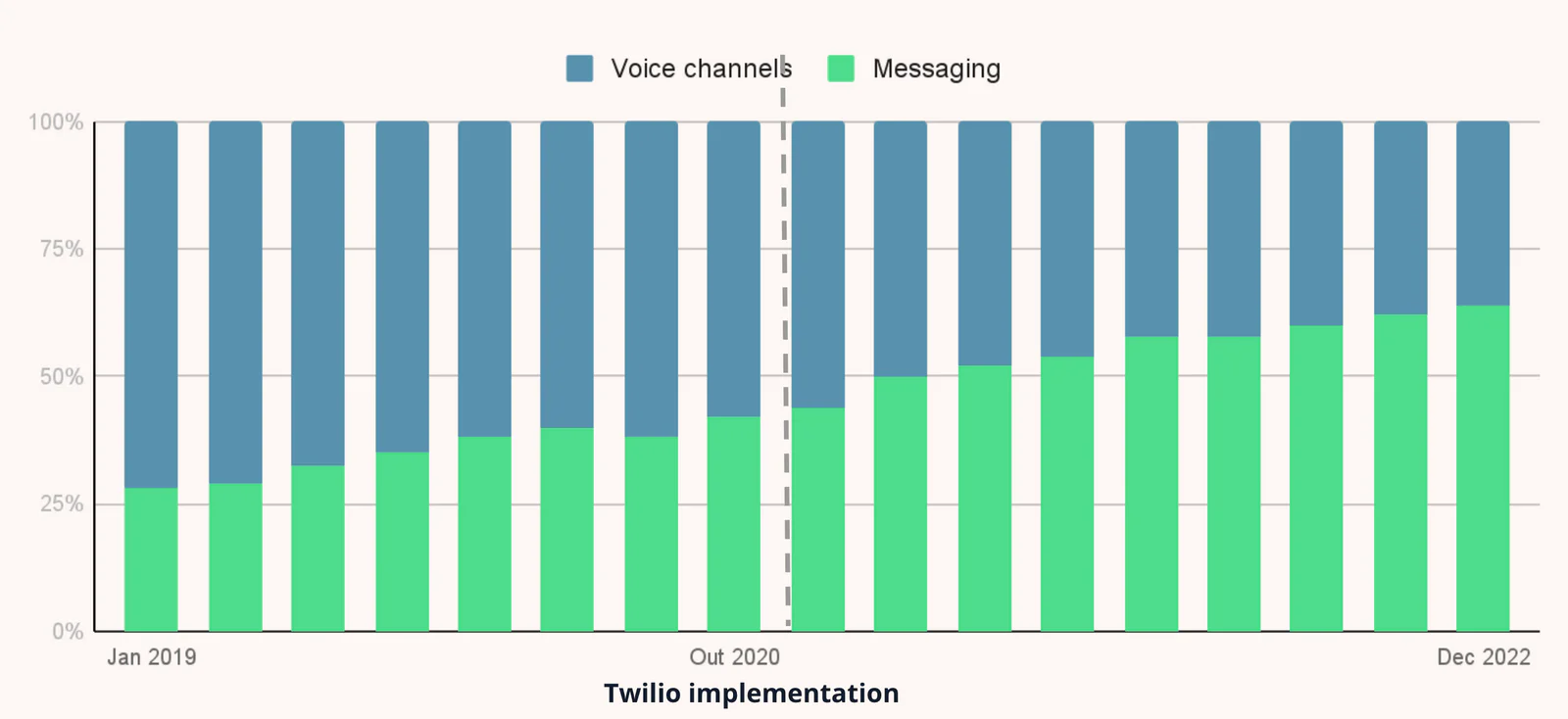
In December 2022, the messaging channel accounted for 65% of customer interactions. In total, in 2022 Stone managed 7.7 million Whatsapp conversations with Twilio’s Customer Engagement Platform. There was a 15% to 56% increase in sales representation on WhatsApp, compared to the inbound sales channel.
According to Stone, Twilio Flex is the most customizable platform on the market, covering all customer contact channels. In addition to providing the necessary tools, the Twilio team has been a trusted partner to Stone. This has resulted in technological advancements and autonomy, ensuring support for future challenges, confirms Yule Silvino Capelle, Product Manager at Stone.
According to Stone, Twilio Flex is currently the most customizable platform on the market, with global reach and all the contact channels they wanted.
"In addition to providing us with all the tools we needed, the Twilio team has always been a true partner we can count on. We have advanced in technology and autonomy, and we know that we can count on our partner for any difficulties that may arise on the horizon."
In 2020, Stone began using Twilio Flex with just one product manager and one developer with React experience. Since then, the company has continued to expand its operations, and within five months they had a minimum viable product that never stopped growing, serving internal and third-party operations, with between 14 and 16 customer service teams using the platform, accounting for around 700 employees using Twilio Flex.
It is important to highlight that, in addition to its functionalities, Flex also allows integrations with Stone’s entire infrastructure context, a feature that is essential for them.
"The fact that Twilio’s Customer Engagement Platform is the most customizable platform on the market made us consider them our top choice from the start."
Once Flex was fully up and running, Stone had all its customer interactions on one platform for the first time, which they called One. Thanks to the platform’s customization capabilities, we were able to add plugins and integrate other tools into Flex, improving the user experience.
In addition, these integrations enabled us to structure highly organized and intelligent data modeling for the business. Today, around 4.4 billion Twilio events pass through the data platform, accounting for around 3.5 terabytes.
“Today, for example, it is possible to share media without downloading it, voice messages, etc. In addition, agents can listen to the audio even if they are not working on that task, which helps them be more productive,” says Yule.
A notable integration was made with the CRM, which enabled the creation of an entire sales journey. In 2022 alone, the team of agents sent more than 4 million HMS, and today they count on a follow-up feature that allows them to take a lead, but only follow up on it at the best time indicated by the customer, scheduling follow-ups for a more favorable moment to close a deal.
One: a consolidated view of customer interactions
Stone’s new customer service center using Twilio Flex has an appropriate name: One. Thanks to its customized development, agents can virtually see all customer interactions on a single screen. This consolidated view, combined with the automation of processes and follow-up routines, has increased productivity for all teams using One.
The speed at which customers are handed off between teams or within the same team has been reduced, and when this does occur, hand-offs to other teams are automated and customers are returned to the same agent whenever possible.
For example, before rolling out Twilio Flex, Stone lacked the means to leverage the wealth of available data that is now used to inform new strategies.
“Today we have a data structure, we have native integration with our data lake, we can listen to events in real time, and build dashboards that give us an analytical view, all of which was not possible before. Today, our entire decision-making structure is supported by data,” says Yule.
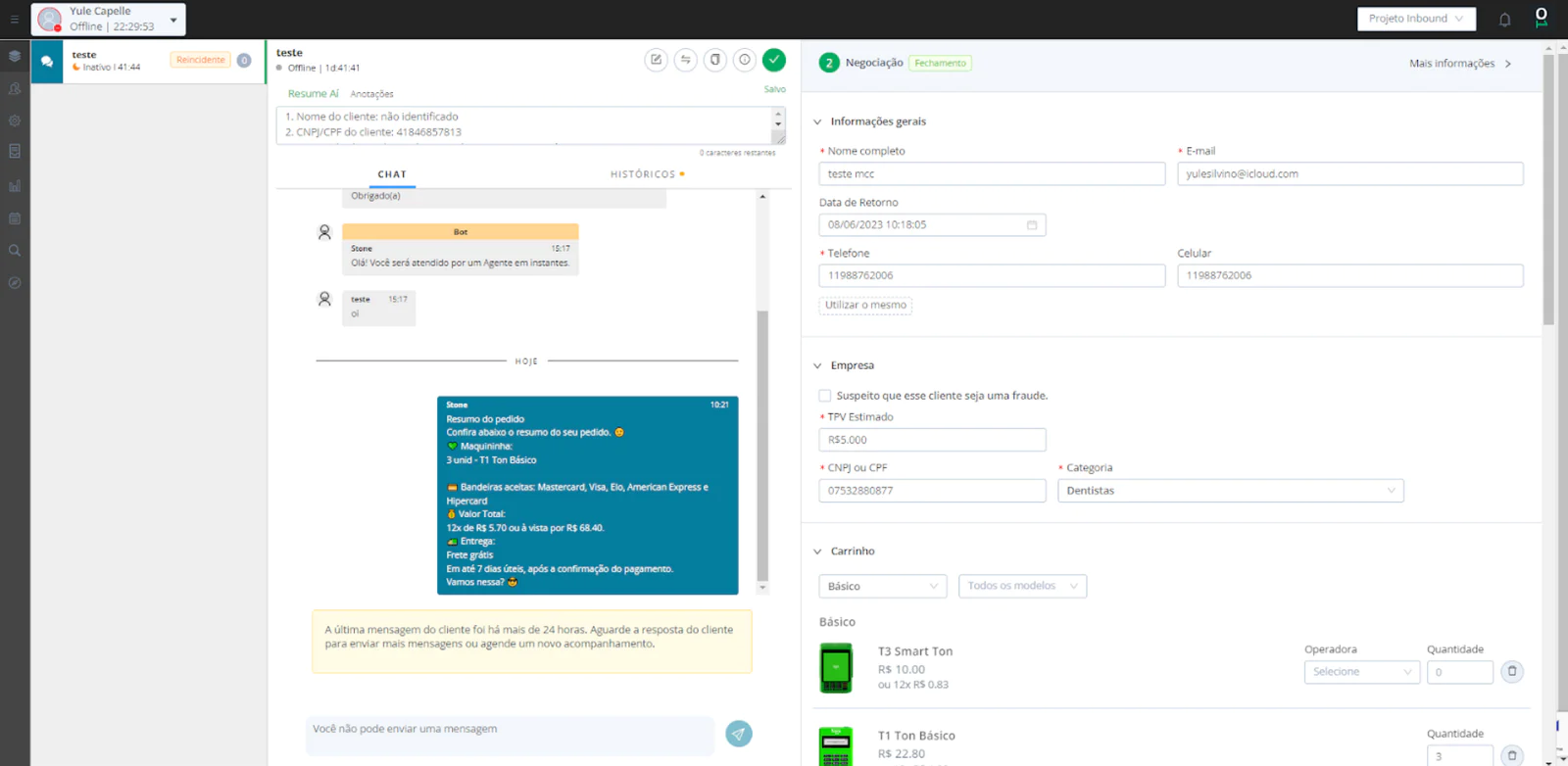
Nowadays, the company monitors queue time, service level, and waiting time, integrates all data on a single screen, and provides additional inputs to make customer service more efficient and satisfactory, with an accurate map of the entire customer service channel journey. In fact, in May 2023, Stone integrated voice service into the Twilio platform, thus bringing all channels together in a single tool.
There are over 600,000 interactions per month, and with the control enabled by Flex, the company can now measure a 25% increase in the customer satisfaction survey (CSAT) response rate, with an average satisfaction rating of 93.9%. Additionally, when customers come back for more help within a certain time of day, they do not have to go through an IVR or service bot again, but can talk directly to a human agent, since even the bots are all integrated with Flex.
"Perhaps the most important highlight is precisely what Flex has done for our team of leaders and customer service representatives, as it has given them the autonomy to better adapt to customer needs."
Currently, teams of enchanters can customize the tool to their most urgent needs without the need for a developer, a feature not available in competing tools on the market. The same applies to leadership teams, who can modify interfaces that enable the management of large teams working 24/7, so as not to interrupt operations and align actions with strategy.
As a result of all the infrastructure and customer experience improvements Stone achieved with Twilio, retailers who need help can now speak to a human agent on the phone within five seconds, 24 hours a day, seven days a week. Stone wants to be available to its customers on their preferred communication channel, at a time that suits them. Being able to anticipate its customers’ problems and refer them to the right team is also a priority. Stone’s customized omnichannel contact center, developed with Twilio Flex, enables them to do just that.
"Not only does it need to be a technological solution that meets operational demands, it also needs to provide autonomy, be customizable, offer ways to improve with each service, and give us possibilities. Greater satisfaction, even with increased operations, is a direct result of this, as is the growth of Stone itself, which is only getting bigger and better because its customers are increasingly satisfied."
Building the future of customer service with artificial intelligence
Artificial intelligence continues to transform all market structures, and customer service is no different. That is why Stone, in partnership with Twilio, and using Twilio Flex, began tracking the journey of the enchanters to understand how AI could transform the way they interact with customers.
Among the services provided by Stone, the company’s central information guide was a website with a large database of articles that presented solutions to a wide range of problems and questions that might arise during a call. This was the starting point for the new features which, building on this database, aim to completely transform Stone’s customer service.
"We have built a solid customer service framework with Twilio, and now we are looking to improve the customer service experience with AI. To this end, we have created pilots for small new features that will change the way Stone is perceived in the marketplace."
Tone, customer service co-pilot
Tone is a customer service co-pilot that draws from the content previously found on Stone’s website. Basically, its function is to replace the enchanters’ manual search using the historuc data stored in the problem-solving database. Tone provides the operation with a detailed step-by-step guide of what needs to be done to solve a wide variety of problems, as well as suggesting the correct classification of the service and problem, without the enchanters having to search for every related keyword.
“Tone already suggests the answers to the problems and the correct classification. Whatever question you have, just ask Tone, instead of reading an entire article on that topic. Basically, it speeds up searches without requiring agents to read beyond what is necessary to help customers on the other end of the line, streamlining the process and solving problems more quickly,” explains Gabriella.
Currently, Tone has an accuracy rate of 84%, and the company aims to reach 90% by the end of 2024. In addition, the users who use Tone the most are the newest agents, as they are the ones who are least familiar with recurring issues that may arise during customer service.
The pilot project has already seen some big changes, like how Tone responds. Before, it was just a big chunk of text, but now it gives bullet points to help solve the problem. Enchanters can check out the response and say if it's useful or correct, and even suggest fixes to train the AI. Today, more than half of the website’s article base is already on Tone.
This pilot project began with 71 people in December 2023, and today there are already 190 agents using the platform. The project is not yet finalized, but it will be soon and will become part of Stone’s entire service structure.
Product suggestions based on a predictive model
As a result of the improvement in agent response times, the proposal is to focus on customer relations rather than just solving problems. Using the predictive model, Stone now suggests to agents new products they can present to the customers they are serving. There is a team dedicated to working on the probability of a customer wanting a different product, training AI to make these suggestions and send only products that have synergy with the customer, which is presented to them during service.
"By offering products that align with the customer’s needs, we were able to resolve issues more quickly and achieve good results. An interesting fact is that the marketing team had a 7% conversion rate in a self-service campaign, with email marketing, while the product suggestion project using the predictive model converted 10.6%. That is the difference that personalized service based on human contact can make."
With this leverage in service quality, it is clear that customers whose problems have been resolved tend to be more loyal to the brand. In addition, the project also positively affected the work experience of the enchanters, as the decision to offer products was in their hands, and the recommendation increased assertiveness.
The Twilio Flex platform, combined with Copilot, where all customer service is performed, also shows which products the customer already has and allows suggestions to be passed on to the sales team when there is a potential conversion. The data is updated daily with what happened in each case.
The entire solution allows Stone’s enchanters to focus more and more on customer relationships and not just on troubleshooting.
ResumeAI: 18,000 minutes saved per day
The third project in this batch, also linked to the previous ones, includes a partnership with OpenAI that allows AI to summarize the consultations carried out in place of the enchanters.
Previously, enchanters took about 1 minute to complete the task, and AI now takes a maximum of 15 seconds, summarizing everything in 5 bullet points. This feature was already part of previous services, thanks to Twilio tools, but is now active for the entire operation.

AI for CSAT: better evaluation of service for constant improvements in operation
The fourth and final feature focuses on the quality of service. When an enchanter finishes a call, they send the CSAT to the customer, whose responses are then evaluated by the quality-control team. With the summary feature, which includes Twilio and OpenAI, the AI itself tells you what the customer's CSAT was.
In the past, the CSAT response rate was only 10%, and the entire experience was evaluated based on those 10% of responding customers. The new model is designed to evaluate all customer service interactions.
“Obviously, humans evaluate AI to determine whether it is reaching the right conclusions, since we are still in the pilot phase. However, we have already achieved 65% accuracy, and we are constantly training the AI to avoid any kind of misinterpretation. In addition, CSATs answered by real customers train the AI, making it possible to see things from the customer’s perspective, not that of other agents," says Yule.
"We are still learning how AI can revolutionize customer service. Our main goal is to understand what we can automate and improve with AI so that our human customer service can increasingly focus on building relationships with our customers, delivering unique and personalized experiences."