How Oroton increased its known-customer rate from 8% to 42% with Twilio Segment CDP & Databricks

Time to read:
The big win
Oroton, Australia’s oldest luxury fashion house, had no shortage of customer data. Their Segment CDP workspace held ~34 million profile records, yet marketing could recognise only 8% of shoppers as known customers. The same person appeared as multiple profiles under different identifiers, anonymous browsing never connected to real customers and audiences built on that foundation couldn’t be trusted enough to activate.
Working with Data and AI delivery partner xponent.ai, Oroton rebuilt its customer data foundation around a single Universal Customer ID, pairing Twilio Segment CDP’s identity resolution and governance with warehouse-scale data engineering in Azure Databricks. The result: 34 million fragmented records resolved into 1.34 million real, de-duplicated customer profiles, with the known-customer rate rising from 8% to 42% and a governed foundation the marketing team can finally build on with confidence.
About Oroton
Founded in 1938, Oroton is an iconic Australian luxury fashion brand synonymous with craftsmanship, accessible luxury and a unique Australian sense of beauty. With a growing store network and expanding online commerce, Oroton runs its customer data stack on Twilio Segment CDP and Azure Databricks, connecting its BigCommerce web store, NewStore point-of-sale and marketing platforms.
The challenge of fragmented customer identities
Every retailer’s personalisation ambition rests on one assumption: that you can tell your customers apart. At Oroton, there was no centralised solution across platforms.
Different systems keyed customers differently, some events identified people by a platform-specific ID, others by email address, so the same shopper was created independently across systems, with no mechanism to stitch them together or coordinate ominchannel profiles. Shoppers who browsed before logging in left behind anonymous profiles that never merged into their real identity, minting a new fragment for every device, browser and cleared cookie. With no tracking plan or schema enforcement in place, events arrived incomplete and inconsistent across web, point-of-sale, and warehouse pipelines.
Over years, the workspace swelled to 34 million profile records, for a customer base a fraction of that size. Only 8% of profiles were known customers. Computed traits produced inaccurate values because the identity foundation beneath them was wrong; audiences existed in Segment Engage but were never activated. A VIP customer and an anonymous session were, in practice, indistinguishable.
"We were running separate campaigns across different platforms and channels but knew we were missing out on the full customer picture. This limited us in how and where we could communicate with our customers."
From fragmented records to unified customer profiles
The turnaround began with a decision about identity: A dedicated, agnostic Oroton Universal Customer ID. This new ID would operate as Segment CDP’s userId and be generated across all channels whenever a shopper was identified. Every subsequent workstream served that principle.
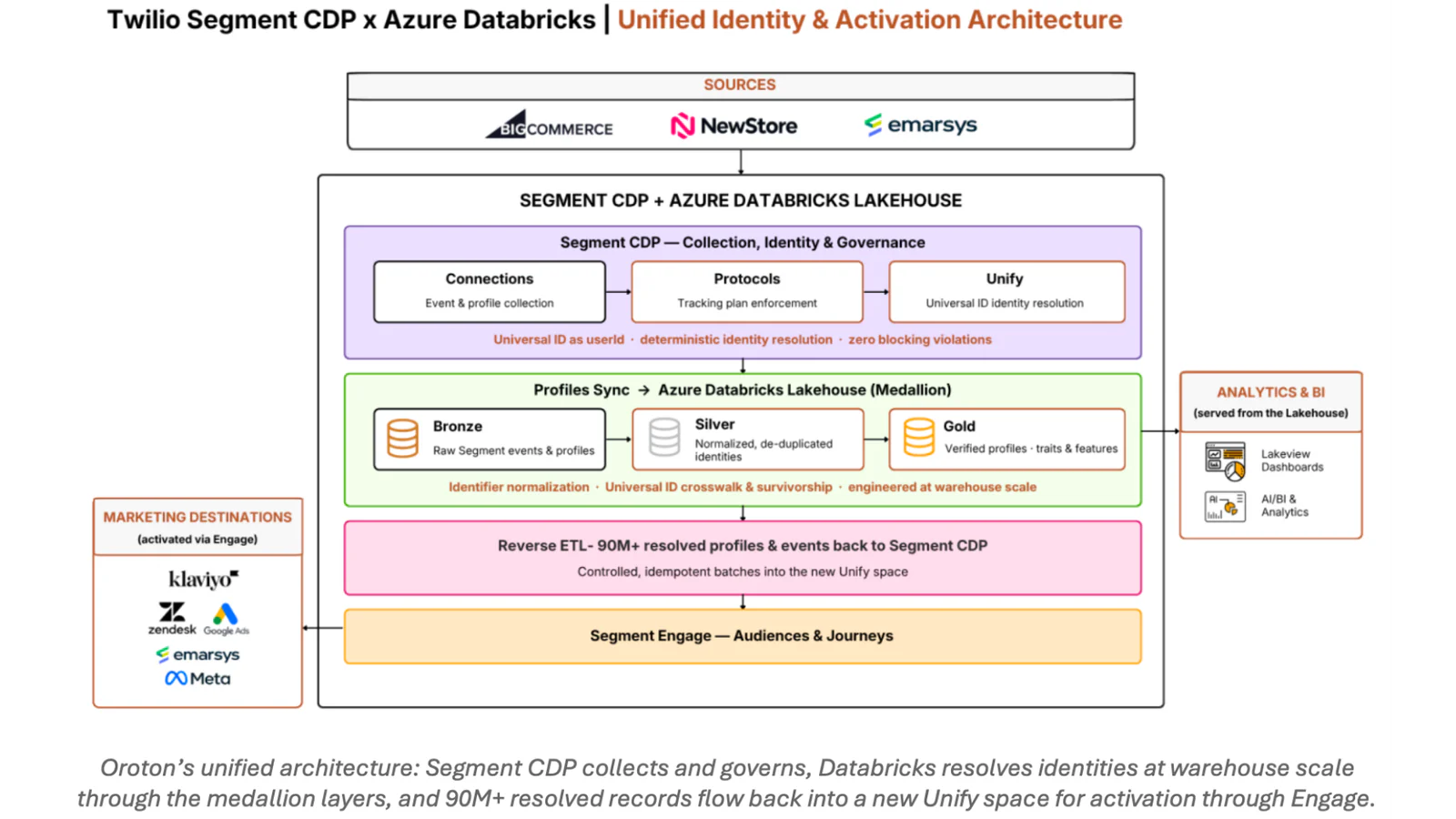
Rather than patching the existing workspace, the team rebuilt from the warehouse up. Segment CDP Profiles Sync landed the full historical estate in Azure Databricks, where every identifier could be examined at scale rather than sampled. There, xponent.ai engineered the resolution. Identifiers were normalised so variants of the same identity collapse together; a Universal ID crosswalk with explicit survivorship rules deterministically mapped each real customer to exactly one identity and validity gates excluded test users, malformed identifiers and wrongly keyed records.
A foundation that can’t fragment again
Resolving history is only half the job, the new space had to be protected from re-accumulating the same debt. The Unify space was configured with the Universal ID as the primary identifier, normalised email and phone as secondary identifiers, and blocked-value rules to prevent bad merges. Identify calls were specified for every trigger across web and point-of-sale and login stitching now merges pre-login anonymous browsing into the known customer’s profile.
Where no tracking plan previously existed, a full plan is now enforced through Segment CDP Protocols: Track events conforming to the Segment CDP eCommerce spec, required-field enforcement and identifier normalisation, with violations driven to zero blocking errors. Consent is standardised on the profile, so compliance behaviour is consistent across every destination.
The results are visible in the identity graph itself: 42% of profiles in the new space are known, reachable customers, up from 8% and each one carrying purchase history, browsing behaviour, in-store transactions and engagement traits in a single golden record.
From trusted profiles to precision marketing
With identity deterministic and traits rebuilt on the corrected foundation, the new space is activation-ready from day one. Audiences are built in Segment Engage on trait logic the team can now trust, ready to activate to any destination, without a data-quality question standing in the way. Parts of that activation layer are already proving the foundation in production.
"Having the single view of customer has enabled us to plan better omnichannel strategies, avoid marketing fatigue and prioritise personalisation across all channels."
What’s next
With a governed identity foundation spanning Segment CDP and Databricks, Oroton’s customer data now works as one connected system, creating a trusted foundation for the next phase of its customer experience strategy. This foundation can support deeper personalisation across digital and in-store touchpoints, more precise audience segmentation and activation, with more relevant lifecycle journeys across marketing channels.
It also creates opportunities to develop richer customer insights, including customer lifetime value, purchase propensity, churn risk, product and category affinity. As Oroton continues to mature its customer data capabilities, the same governed profiles can support real-time decisioning, cross-channel journey orchestration, advanced measurement and AI-driven customer experiences, giving teams across the business a consistent and trusted view of the customer on which to build.